Hunting History avatar

Hunting History

29 December, 18:41

Champawat tigress story.


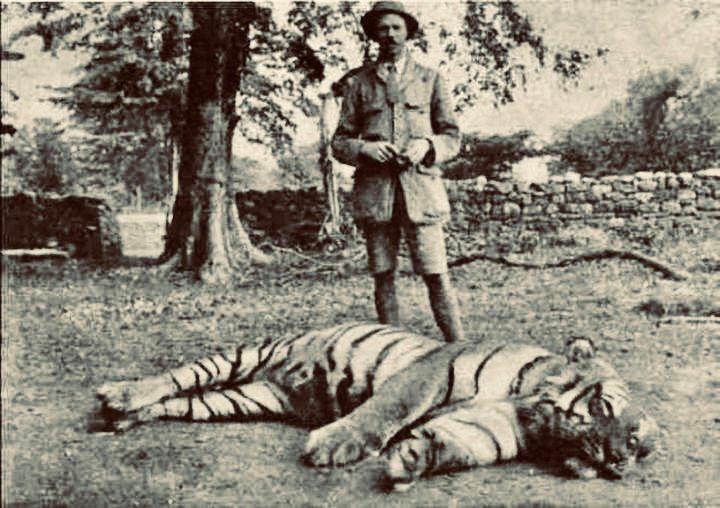
Man-eating tiger that killed 436 people Real Photo: 1911 Nepal, Jim Corbett

In the early 1900s, the remote foothills near the Nepalese Himalayas became the stage for one of the most horrifying episodes in predator history—the reign of the infamous Champawat tigress, the deadliest man-eating tiger ever documented. Villages lived in dread as people—men, women, and children—disappeared one after another, snatched silently from fields, paths, and even the edges of their homes. Panic spread swiftly. Locals whispered of vengeful spirits or divine punishment, but the true culprit was flesh and blood: a Bengal tigress whose predatory behavior had turned lethally human-focused.

Her story began in Nepal, where she was responsible for an estimated 200 deaths. Authorities responded with military force—hundreds of soldiers, armed villagers, and organized drives swept the forests, yet the tigress vanished like mist after every encounter. Her cunning, stealth, and intimate knowledge of the terrain made her untouchable. Finally, under unrelenting pressure, she crossed into British India, taking refuge in the dense sal forests of the Kumaon region.

But safety was an illusion. Once settled in India, the Champawat tigress resumed her killing with renewed boldness. No longer restricted to twilight hours, she hunted in broad daylight, stalking near villages and striking with terrifying audacity. Entire communities shut down in fear. Farmers abandoned their fields, children stopped attending school, and daily life ground to a halt. For four long years, the Kumaon region existed under siege, its people prisoners in their own homes whenever a distant roar echoed through the hills.

Bounties were posted. Professional hunters arrived from across the subcontinent. Even elite Gurkha units stationed in Almora were deployed in coordinated efforts to corner her. Yet every attempt failed. The tigress of Champawat seemed to mock her pursuers—elusive, intelligent, and utterly relentless. With the death toll climbing past 400, local officials knew they needed someone extraordinary. They turned to Jim Corbett, already renowned for his skill in tracking and eliminating man-eating predators.

Jim, however, was no mercenary. He agreed to hunt the Champawat tigress only under two conditions: first, that all armed patrols and military personnel be withdrawn to prevent accidental shootings during his solo tracking; and second, that no reward be offered—he refused to be seen as a trophy hunter profiting from tragedy. Desperate, the authorities accepted immediately.

In 1907, Corbett arrived in Kumaon. His approach was methodical and quiet, relying not on brute force but on patience, observation, and deep understanding of tiger behavior. His break came after the tigress killed a 16-year-old girl collecting firewood. Corbett followed the trail—a grim path marked by blood splatters, torn clothing, and fragments of bone—deep into the forest. There, after hours of silent stalking, he confronted the beast. A single, well-placed shot ended Champawat tiger reign of terror.

Upon examining her body, Corbett uncovered the tragic reason behind her deadly turn: both right-side canine teeth were severely damaged—the upper broken in half, the lower shattered to the gumline. Evidence pointed to an old gunshot wound, likely sustained during an earlier encounter with a Nepalese hunter. That injury had robbed Champawat tigress of the ability to grip and kill natural prey like deer or wild boar. Forced by pain and hunger, she turned to humans—slower, softer, and tragically easier targets.

The final tally was staggering: 436 confirmed kills, with countless unreported deaths likely pushing the number even higher. The Champawat tigress remains the most lethal individual man-eating tiger in recorded history. Yet Corbett’s insight transformed her legacy. He did not celebrate tiger death as a victory over evil, but mourned it as the tragic consequence of human interference.

This experience profoundly shaped Corbett’s worldview. In his later writings—most notably in “Man-Eaters of Kumaon”—he argued that tigers rarely attack humans unless driven to it by injury, old age, or loss of habitat. His work laid the groundwork for modern wildlife conservation in India and redefined ethical hunting as an act of protection, not conquest.

The first Indian edition of Jim Corbett's Man-Eaters of Kumaon was published by Oxford University Press in Bombay (Mumbai) in 1944, two years before its UK/US releaand is a rare, collectible version distinguished by being taller, containing an extra chapter ("Just Tigers"), and featuring photos. Due to wartime paper shortages, print runs were small (1200-1500 copies), making these signed, association copies especially valuable, with some featuring handwritten corrections by Jim Corbett himself.

"Man-Eaters of Kumaon" by Jim Corbett has been reprinted numerous times since its first publication in 1944. Exact reprint numbers vary by publisher and edition, but it has seen dozens of reissues worldwide. The total print run is estimated to exceed 1.000.000 (one million) copies globally.

Today, the story of the Champawat tigress endures as both a cautionary tale and a pivotal case study in human-wildlife conflict. For hunters her name symbolizes the fragile boundary between fear and understanding. She was not a demon, but a wild animal pushed to extremity.

The legacy of the Champawat tiger lives on, not just in the annals of hunting lore, but in the ongoing efforts to coexist with the predators that share our planet. Her story urges respect, caution, and above all, responsibility—lessons as vital now as they were in 1907. Whether you’re drawn to tales of big cat encounters, the ethics of predator control, or the history of man-eating tigers, the Champawat tigress remains a defining figure whose impact echoes through every forest, village, and conservation effort in India and beyond.

Champawat tigress story.

10

Comments

1

Newest first

Rifleman Tracker avatar

4 February 2025

US flag
The story of the Champawat tigress reminds us of the complex and often tragic relationship between humans and wildlife. The tigress was not simply a bloodthirsty predator; her story is one of survival in extreme circumstances. The damaged canines that hindered her ability to hunt....

Scan the QR code on your phone to download